
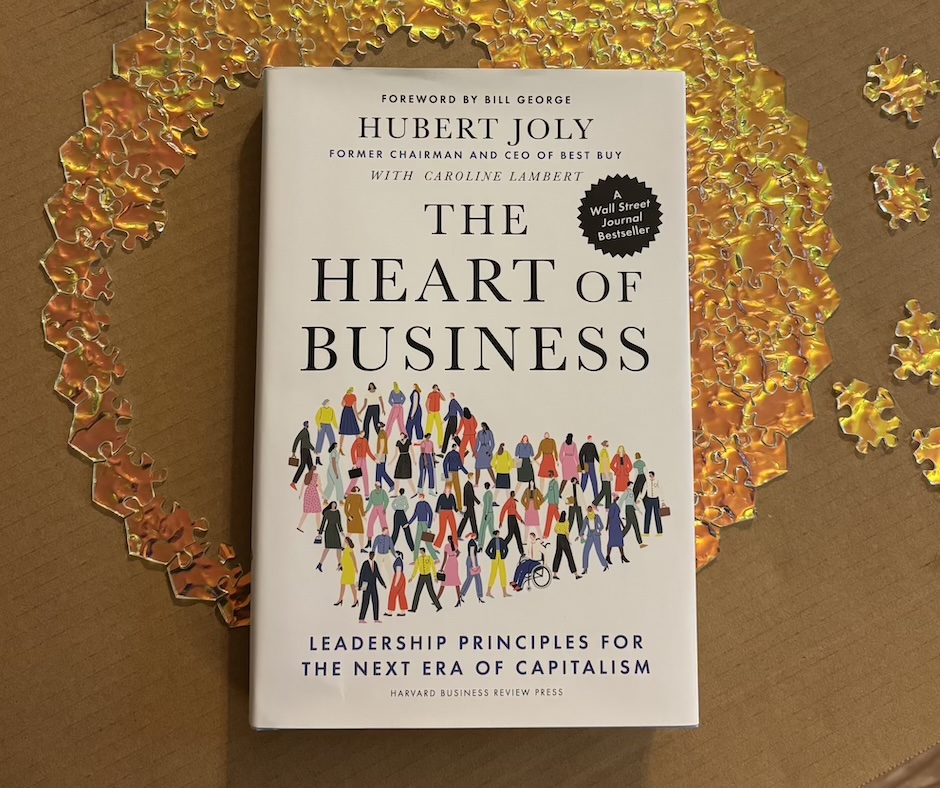
I recently finished The Heart of Business by Hubert Joly, the former CEO of Best Buy. He shares how he ditched the traditional corporate profit-first mindset and rebuilt the company around a people-first approach. The results were remarkable: in an era when retail was struggling, Joly led to Best Buy to six straight years of growth, and its stock rose from a low of $11.37 in 2012 to a $88 in 2019 – a 774% increase.
For the past 15 years, I’ve been advocating for a business approach that prioritizes people over profits. I’ve mostly focused on small businesses where owners can shape the purpose directly. And I’ve assumed large corporations couldn’t do the same. That’s why Joly’s story is so encouraging. It shows that a people-first model can work at scale, and it gives me hope that more corporations will follow Joly’s example (he’s now teaching the next generation of business leaders at the Harvard Business School).
Here’s a few takeaways from the book:
1) Purpose Over Profit
Businesses shouldn’t be driven solely by profit. Instead, they should have a noble purpose that serves a broader mission. Best Buy’s mission is “Enriching lives through technology.”
2) People at the Center
Companies should treat employees not just as “human capital” but as individuals with intrinsic value. Joly’s priorities were: People → Business → Finance. First focus on people, then on business (customers), and then profits follow.
3) Mastery & Learning
Companies should foster a culture of learning, coaching, and experimentation. Performance systems should focus less on ranking and more on development. People should be encouraged to improve, take risks, and sometimes fail, because that’s part of growth.
4) Autonomy and Decentralization
Decision-making should be pushed as far down as possible: local teams (e.g. store managers and staff) must have the ability to make decisions because they’re closest to the customers. This autonomy not only empowers people but also enables innovation and speed, because the organization isn’t bottlenecked at the top.
5) Turning Challenges into Opportunities
Instead of seeing challenges as threats, Joly suggests reframing them as tailwinds: they can become sources of innovation and momentum.
6) Stakeholder Interdependance
Joly argues for a model of business that sees all stakeholders (employees, customers, suppliers, communities, shareholders) as interdependent. A “purposeful human organization” sees business as a community with responsibility to contribute positively to society.
7) Redefinition of Work
Joly reframes work as a source of meaning: work is not just a transaction but a way for people to contribute, grow, and connect.
Early in his life, Joly spent time with monks from the Congregation of St. John, and that experience profoundly shaped his views on meaning, purpose, and work. He came to see work as an expression of love and service. It’s inspiring to see a leader whose faith directly shaped both his leadership and the direction of a major company like Best Buy.